
Advertisement



September 2012


MANAMA
CAPITAL
OF
ARAB
CULTURE
2012
CAPITAL
OF
ARAB
CULTURE
2012


Join artBahrain.org
September
Art Escape
The Beirut Art Fair, which had its third iteration in early July, perfectly reflected the unique city in which it was held.
The BIEL exhibition center, which hosted the fair, is a slightly moldy and dated 1970s yellow building wedged between Bice restaurant and the ultra-glam Sky Bar on one side, and piles of rocks in a dirt lot on the other -- all facing a view of the Mediterranean sea bathed in mid-summer light. The scene for visitors to the fair evoked an almost schizophrenic glimpse into the life of a city perpetually holding its breath, constantly rebuilding and praying that the next disaster will never come.
The BIEL exhibition center, which hosted the fair, is a slightly moldy and dated 1970s yellow building wedged between Bice restaurant and the ultra-glam Sky Bar on one side, and piles of rocks in a dirt lot on the other -- all facing a view of the Mediterranean sea bathed in mid-summer light. The scene for visitors to the fair evoked an almost schizophrenic glimpse into the life of a city perpetually holding its breath, constantly rebuilding and praying that the next disaster will never come.
Copyright © 2010, artBahrain.org. All rights reserved. Use of this site constitutes agreement with our Terms and Conditions.

Highlights Beirut Art Fair
By Laura Stewart
By Laura Stewart
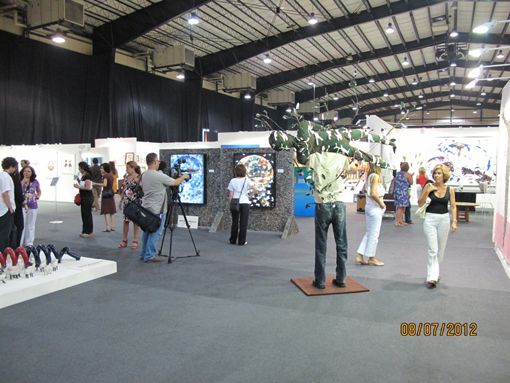
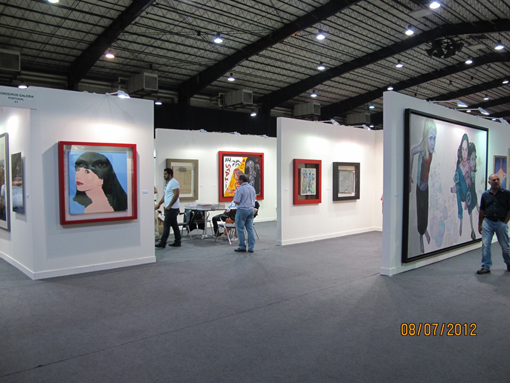
Inside the fair, 44 dealers -- heavy on local Lebanese, with a sprinkling from Europe, Asia and beyond, exhibited art and objects ranging from vulgar to exquisite, maudlin to joyous. The wares on view ranged from comic book art, to jewelry to mid-century modern furniture to abstract oil paintings to photographs and conceptual installations.
Much of the work referenced ancient Arabic or futuristic themes. Yet, interestingly, for the Western visitor, very little of the art was overtly political, with very few thematic references to either the Israeli-Palestinian situation, Arab Spring, or the Syrian upheaval, literally smoldering several miles away on the Southern Lebanese border.
But, perhaps it makes sense, that in a place in which life itself is political, and the mere art of surviving day to day is difficult -- the art fair, like the city, chose to celebrate the sensual, the aesthetic, the humorous and the optimistic in much the same way the inhabitants of Beirut choose to celebrate life in fifth gear -- partying until dawn.
But, perhaps it makes sense, that in a place in which life itself is political, and the mere art of surviving day to day is difficult -- the art fair, like the city, chose to celebrate the sensual, the aesthetic, the humorous and the optimistic in much the same way the inhabitants of Beirut choose to celebrate life in fifth gear -- partying until dawn.
With the caveat that this publication is far from lacking in bias; one of the most striking booths showed ten works by Bahraini painter, Rashid bin Khalifa, all from his recent “Reflection” show on view last winter at Bahrain Financial Harbour.
The elegant and simple enamel works on reflective chrome and white lacquer convex, were highly admired. The juxtaposition of these large and striking abstract works -- most in monochromatic red, black, or white -- prompted many visitors to single out the booth, and comment on the unique materials and cutting edge nature of the work.
The elegant and simple enamel works on reflective chrome and white lacquer convex, were highly admired. The juxtaposition of these large and striking abstract works -- most in monochromatic red, black, or white -- prompted many visitors to single out the booth, and comment on the unique materials and cutting edge nature of the work.
However, Shaikh Rashid’s work was, of course, not the only artwork of interest or quality in the show. Overall, the fair featured better decorative and design art, furniture and photographs than pure oil on canvas, or sculpture.
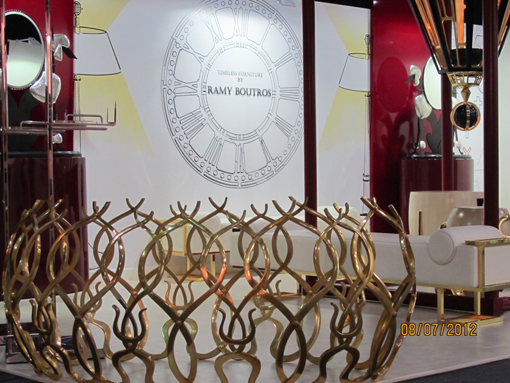
For example, two of the most interesting booths featured cutting-edge interior design with Arabic grounding and a contemporary twist. Or as the prominent Lebanese designer, Ramy Boutros describes his work, “Revolutionary, extravagant, eccentric, a fusion of style, materials and techniques... these are my creations!” Boutros‘booth featured opulent gilded bronze “egg” chairs”, oversized gilt lanterns and geometric white leather divans with gilded rolled ends -- worthy of Cleopatra.
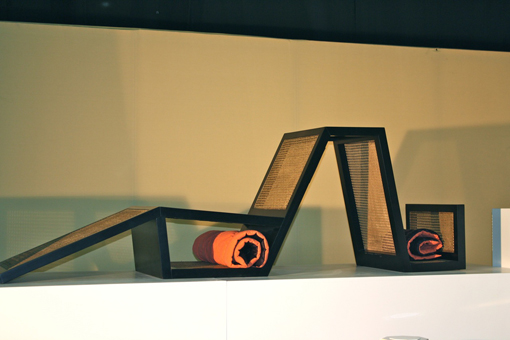
In a more low-key academic vein, Carwan Gallery of Beirut, founded by the architects Pascale Wakim and Nicolas Bellavance-Lecompte in 2010, had a fascinating exhibition of contemporary furniture by Vienna-based Austrian designers, Katharina Mischer and Thomas Traxler’s design studio mischer’traxler.
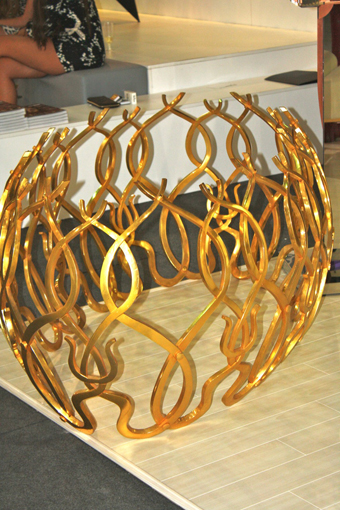
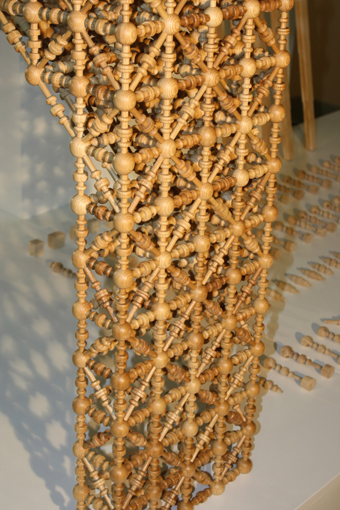
One sideboard/console table was composed of a network of more than 650 distinct pieces of carved wood. “Mischler’traxler teamed up with an expert woodworker in Lebanon to redefine the constructive system of the traditional mashrabiyas - delicate wooden window screens often found in the Middle Eastern achritecture,” explained Nicolas Bellavance-Lecompte, the gallery’s charismatic director.
“Inspired by the process of lathing the small wooden parts of mashrabiyas, the design is focused on exposing the many steps of production, to make the craftsmen’s work visible and understandable to the observer with the result, a sideboard table composed of a network of more than 650 distinct pieces of manually carved wood”.
“Inspired by the process of lathing the small wooden parts of mashrabiyas, the design is focused on exposing the many steps of production, to make the craftsmen’s work visible and understandable to the observer with the result, a sideboard table composed of a network of more than 650 distinct pieces of manually carved wood”.

|

|

|
|
|
|

|

|

|

|

|

|

|

|

|

|

|

|

|

|

|

|

|

|

|

|

|
|
|

|

|
|
|
The photography on view at the fair was also superior to most of the original artwork. For example, Waddah Farris, the resilient Baghdad dealer, who has been showing in galleries in Beirut and Barcelona since the war (see artbahrain.org July/August 2011) showed eerie orange-y, backlit photographs by famed Iraqi architect and author, Rifat Chadirji, from The Palm Massacre series.
Lateefa bint Maktoum, the Dubai-based artist, who founded the art space Tashkeel, in the Nad Al-Sheba district, showed signature photographs, which chronicle the changes taking place in Dubai in elegant, tonally, and compositionally simple works that belie the work that goes into them.
As Maktoum explains,”When making photographs, I choose the color palette much as a painter would choose the paints that will be applied onto a canvas. From there I take my camera on a journey as I seek out these colors from different places, usually at similar times of the day and taken under natural light. This way, when I digitally combine what has been shot, it looks as close to reality as possible.
Not all at the Beirut Fair was a-political or lacking in irony. Hanging in the VIP lounge, decorated with white leather contemporary chairs, stainless steel and sugar-pink lighting hung a work by controversial Lebanese artist, Zena al Khalil. Quaffing copious amounts of champagne, the VIP visitors leaned over the bar to look at a Warhol-esque acrylic and glitter painting in hot pink of Hezbollah activist and extremist, Hasan Nasrallah.
At the side of the painting al Khalil had titled the work, Super Star, and wrote the following: “This is a portrait of a man who, overnight, turned into an international media sensation. Regardless of my political opinions, his voice was the one I waited to hear. I find that by painting him, perhaps I can break past the media pop star, and try to get to know the human being who has come to have such an overwhelming presence in my life”. Welcome to MENASA 2012.
Lateefa bint Maktoum, the Dubai-based artist, who founded the art space Tashkeel, in the Nad Al-Sheba district, showed signature photographs, which chronicle the changes taking place in Dubai in elegant, tonally, and compositionally simple works that belie the work that goes into them.
As Maktoum explains,”When making photographs, I choose the color palette much as a painter would choose the paints that will be applied onto a canvas. From there I take my camera on a journey as I seek out these colors from different places, usually at similar times of the day and taken under natural light. This way, when I digitally combine what has been shot, it looks as close to reality as possible.
Not all at the Beirut Fair was a-political or lacking in irony. Hanging in the VIP lounge, decorated with white leather contemporary chairs, stainless steel and sugar-pink lighting hung a work by controversial Lebanese artist, Zena al Khalil. Quaffing copious amounts of champagne, the VIP visitors leaned over the bar to look at a Warhol-esque acrylic and glitter painting in hot pink of Hezbollah activist and extremist, Hasan Nasrallah.
At the side of the painting al Khalil had titled the work, Super Star, and wrote the following: “This is a portrait of a man who, overnight, turned into an international media sensation. Regardless of my political opinions, his voice was the one I waited to hear. I find that by painting him, perhaps I can break past the media pop star, and try to get to know the human being who has come to have such an overwhelming presence in my life”. Welcome to MENASA 2012.